
A wallet address is enough when your only question is: “Where should the funds go?”
A crypto payment link is better when the payment also needs an amount, purpose, token, network, deadline, customer context and a status you can follow.
The buyer still sends an on-chain transfer to your wallet. The difference is that a payment link places a tracked invoice and checkout around that transfer. Instead of reconstructing the agreement from chat messages after the payment, you define the expected payment before it happens.
For a freelancer, agency or small seller, the practical rule is simple:
Use a wallet address for an informal transfer you are prepared to verify manually. Use a payment link for a business payment that must be connected to a particular client, order or milestone.
If you need the underlying concept first, read how crypto payment links work. This article focuses on the operational decision: when the extra invoice layer is worth using.
Crypto payment link vs wallet address
A wallet address identifies a destination on a blockchain. It does not normally contain the commercial details of the sale.
A tracked payment link opens a checkout for one invoice. It can show the buyer the payment purpose, amount, available tokens and networks, recipient address, QR code, time remaining and current status.
| Question | Wallet address in a message | Tracked payment link |
|---|---|---|
| Where are the funds sent? | Merchant wallet | Merchant wallet |
| Who controls the funds? | Merchant | Merchant |
| Is a website required? | No | No |
| Is the amount part of the request? | Written separately | Displayed in checkout |
| Is the token and network clear? | Must be explained in chat | Selected from enabled routes |
| Is there an order or invoice ID? | Usually no | Yes |
| Can the seller add a payment purpose? | Stored in the conversation | Shown with the invoice |
| Can the seller keep a private reference? | Stored elsewhere | Saved as a private note |
| Does the request expire? | Usually unclear | Has a visible payment window |
| Can both sides see a status? | Requires manual checking | Connected to invoice status |
| Does it prevent every incorrect payment? | No | No |
| Is it suitable for automated orders? | No | Use a website or API flow |
A payment link is not a different type of blockchain transfer. It is a better-organised payment request.
What is missing when you send only a wallet address?
Consider this message:
Send 500 USDT to
0x71a4...93F2.
It appears simple, but it leaves several questions unanswered:
- Which network should the buyer use?
- Is the seller expecting exactly 500 USDT?
- Is the amount still valid tomorrow?
- What product, service or milestone is being paid for?
- How will the seller distinguish this transfer from another 500 USDT payment?
- What should the buyer do if the transfer is not recognised?
- When is it safe for the seller to deliver the work?
Those details may exist elsewhere in the conversation, but the address itself does not carry them. If the discussion spans several days or moves between employees, email and Telegram, the final payment instructions can become fragmented.
A payment link moves the relevant details into one checkout connected to one invoice.
Use a payment link when the network matters
Stablecoins with the same ticker exist on multiple blockchains. USDT on Ethereum, TRON and Solana are not the same payment route. USDC also has different token contracts on different networks.
Tether explicitly asks integrators to make supported protocols clear to users and lists separate implementations for different chains in its official protocol guide. Circle likewise publishes distinct USDC contract addresses for every supported blockchain.
A raw address does not always make the expected network obvious. This is particularly dangerous with EVM networks, where the same-looking 0x address may be valid on Ethereum, Base, BNB Smart Chain, Polygon, Arbitrum and Optimism.
Important: standard
0xaddresses look identical across EVM networks. A GramPayBot checkout requires the buyer to choose one of the merchant’s enabled routes before presenting the final network, address and exact amount.
A payment link gives the buyer a controlled process:
- The merchant enables the networks and tokens they accept.
- The buyer selects one of those routes in checkout.
- Checkout displays the address and exact amount for that selection.
- The buyer uses the same token and network in their wallet or exchange.
The buyer can still choose incorrectly outside checkout, but there is now one clear source of truth for what the invoice expects. Before requesting payments, configure only the routes you can support; see wallets and networks.
Use a payment link when the amount must be exact
A wallet address can receive many transfers of many amounts. It does not tell the buyer how much this particular request requires.
When the amount is written separately in chat, several problems can appear:
- the buyer uses an earlier price from the conversation;
- the buyer rounds the token amount;
- the buyer deducts a withdrawal or network fee;
- the seller changes the scope but forgets to update every message;
- two clients send the same amount to the same address.
A tracked invoice fixes the expected amount before payment. With GramPayBot, the seller enters the agreed amount in USD and checkout displays the exact USDT or USDC amount for the selected route.
The payment matcher can then compare the received transfer with the invoice instead of treating any incoming amount as success. It checks the expected network, token, recipient, exact amount and invoice time window, and it does not reuse the same transaction for another invoice.
This does not make underpayments or overpayments disappear. It makes them visible as exceptions instead of silently treating them as successful payments.
Use a payment link when you need to know who paid
A blockchain shows that a transfer occurred. It does not automatically tell your business which customer, conversation or order it belongs to.
Suppose three clients each owe your agency $1,000. If you send all three the same wallet address, the incoming transfers may look very similar. You then have to rely on timing, sender-provided transaction hashes or messages such as “I paid.”
That process becomes fragile when:
- clients pay from exchanges whose sending addresses they do not control;
- one client pays late;
- two clients send similar amounts close together;
- a client sends a transaction hash from an earlier payment;
- another employee needs to reconcile the payment.
A payment link gives every request its own invoice ID and business context.
The public description might say:
Website project — milestone 2
The private note might say:
ACME · proposal PR-2026-041 · Maria
The buyer sees the first value. Only the seller sees the second. Together they help both sides recognise the request without exposing internal customer information in checkout.
Use a payment link when payment has a deadline
A wallet address remains usable until you stop controlling it. A message containing that address usually does not communicate whether the commercial request is still open.
That matters when:
- the exchange rate or quoted price may change;
- inventory or availability is limited;
- the buyer returns to an old conversation;
- the project scope has changed;
- the seller has cancelled or replaced the request.
A payment link can have a defined payment window and status.
In the current manual GramPayBot flow, an invoice is active for 30 minutes. If it remains unpaid, it moves out of the active payment window. The seller can create a new invoice with current terms instead of asking the buyer to use an old request.
Expiry does not cancel a blockchain transaction that was already sent. A late transfer may still require review. The benefit is that the system does not pretend an old request remains unconditionally valid.
Use a payment link when the buyer needs clearer checkout
Sending an address makes the buyer assemble the payment themselves. They must find the correct message, copy the address, remember the amount, choose a network and decide whether the transfer has completed.
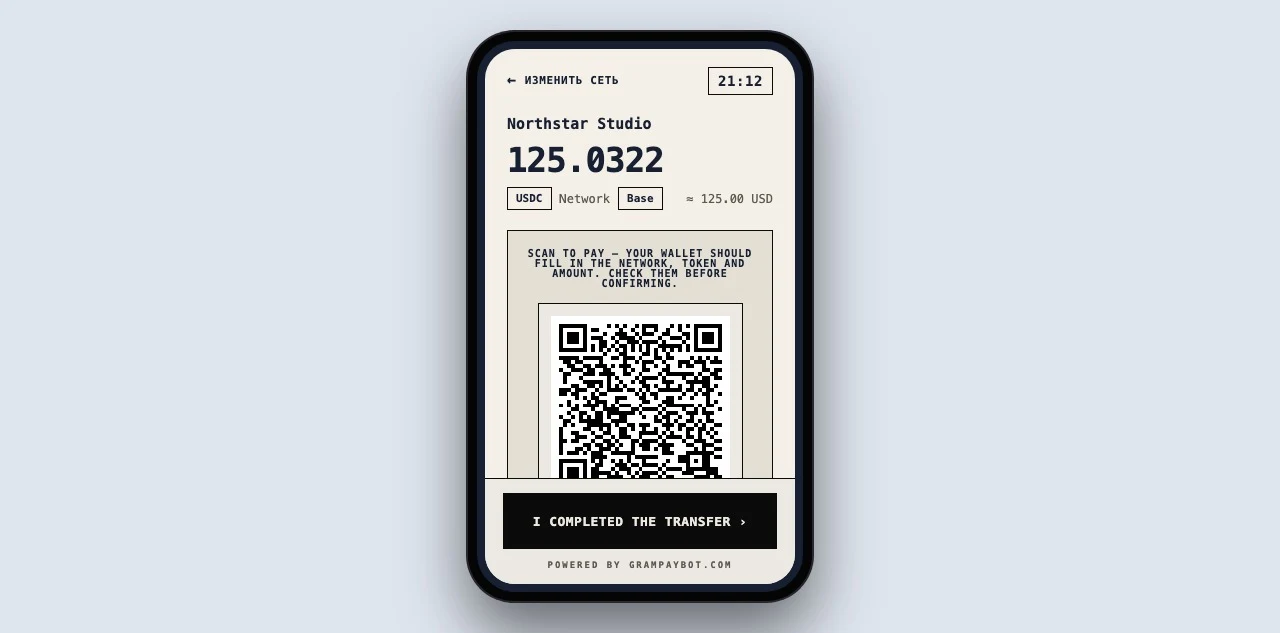
A hosted checkout puts the relevant fields together:
- merchant or project name;
- invoice ID;
- payment purpose;
- USD total;
- available USDT or USDC options;
- selected network;
- exact token amount;
- recipient address;
- QR code;
- time remaining;
- current payment status.
Payment-request standards follow the same general principle. For example, the official Solana Pay transfer-request format can carry a recipient, amount, token mint, reference, label and message instead of leaving every field outside the request.
A clear checkout reduces the number of instructions the buyer must reconstruct from a conversation. It does not remove their responsibility to review the transfer before approving it. The buyer checkout guide shows the complete buyer-facing flow.
Use a payment link when someone else may handle the order
A raw address can work while one person remembers every customer and manually watches one wallet. It becomes harder when another employee, contractor or manager needs to understand the payment.
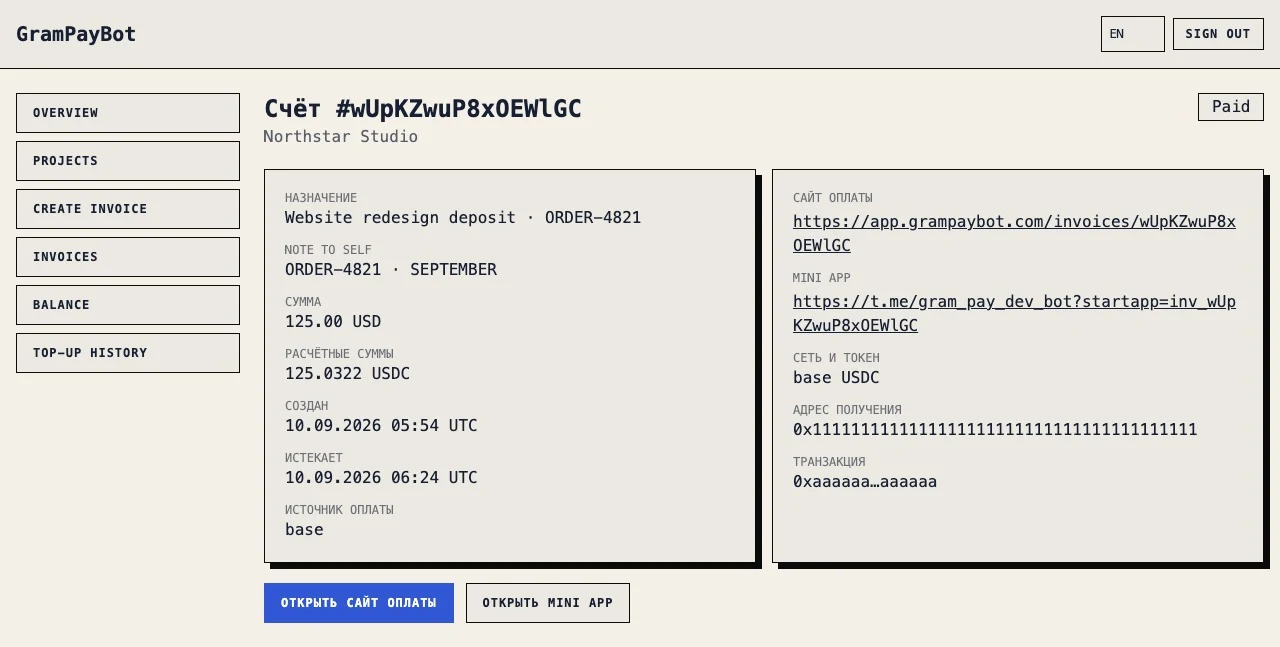
With a tracked invoice, the team can answer:
- Who is expected to pay?
- What is the payment for?
- How much is expected?
- When does the request expire?
- Is it waiting, paid, expired or cancelled?
- Which transaction was connected to it?
- Does the case require manual review?
The private merchant note is particularly useful here. It preserves the operational reference even when the person checking the payment was not part of the original sales conversation.
When a wallet address may be enough
A payment link is not necessary for every transfer.
Sending an address may be reasonable when:
- you are moving funds between wallets you control;
- a trusted counterparty already knows the token, network and amount;
- the transfer does not belong to a customer order;
- there is no deadline or changing commercial quote;
- only one payment is expected;
- you are willing to verify the transfer manually;
- you do not need an invoice history or shared status.
For example, moving USDC from your exchange account to your treasury wallet does not require a buyer-facing checkout. You already know the purpose, route and owner of both accounts.
A one-off reimbursement from a trusted partner may also be simple enough for an address, provided both sides explicitly confirm the network and token.
The moment the payment represents a customer obligation, milestone, deposit or order, an invoice usually creates a cleaner record.
When a payment link is the better choice
Use a payment link when one or more of these conditions apply:
- you are requesting a deposit or milestone payment;
- the buyer receives instructions through chat or email;
- several customers may pay similar amounts;
- USDT or USDC is available on more than one network;
- you need to know whether the request is still active;
- someone else may need to reconcile the payment;
- you need a public description and private order reference;
- delivery depends on a confirmed payment status;
- you want a repeatable process without integrating an API.
You do not need a high transaction volume before using invoices. The first payment that becomes difficult to identify can cost more time than creating the invoice would have taken.
Example: the same $750 agency payment
Imagine an agency requesting a $750 deposit.
With a wallet address
The manager sends:
Please send 750 USDT to
0x71a4...93F2on Base.
The buyer later asks whether Ethereum will work. The manager replies in another message. The buyer sends a screenshot. An operations employee then searches the wallet and asks for the transaction hash to determine whether the transfer belongs to this client.
The payment may still be valid, but the business context is scattered across the conversation.
With a payment link
The manager creates an invoice containing:
- amount:
750.00 USD; - public description:
Landing page project — 50% deposit; - private note:
Northstar · LP-118 · Anna; - enabled routes: the app’s configured USDT and USDC options.
The buyer opens one link, selects a route and sees the exact amount, network, address and timer. The agency follows the invoice status and retains the transaction record with the customer reference.
The underlying transfer still reaches the agency’s configured wallet. The difference is that the payment request and resulting transfer can be understood without reconstructing the chat.
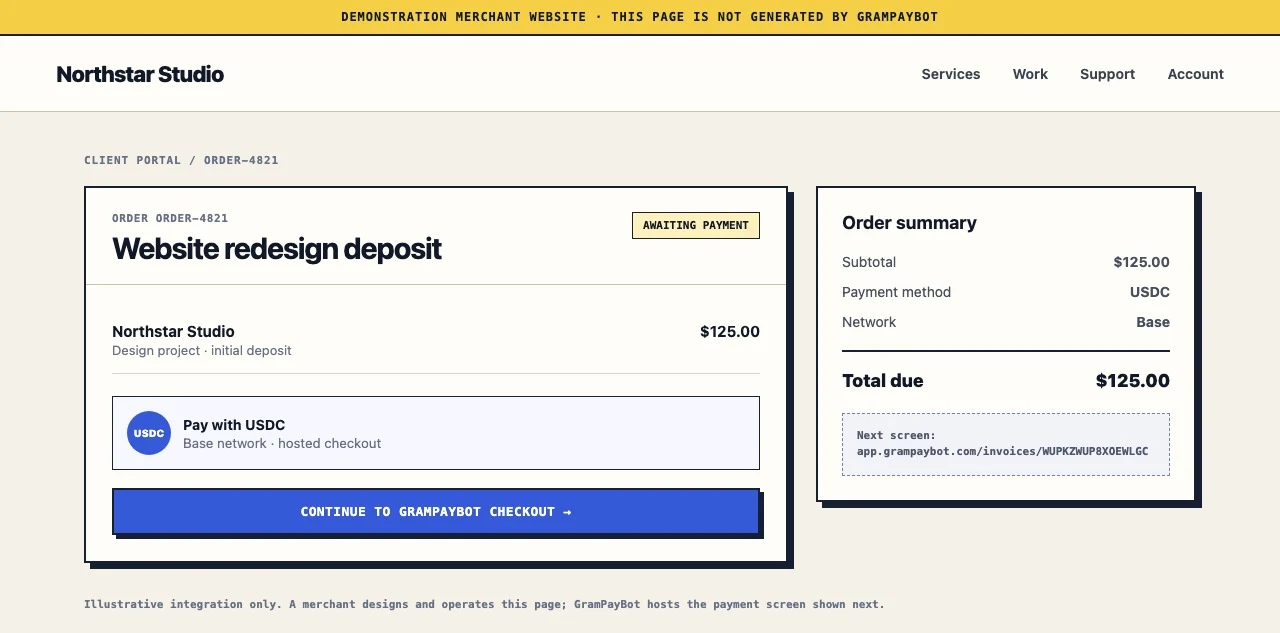
Actual GramPayBot UI captured from the current product with synthetic data. The merchant website is an illustrative integration.
What a payment link still does not solve
A payment link reduces ambiguity; it does not make cryptocurrency reversible or eliminate every payment error.
It cannot guarantee that the buyer:
- selects the correct network in an external wallet;
- sends the correct token;
- pays before expiry;
- sends the exact amount;
- avoids deducting an exchange withdrawal fee;
- sends from a service that provides timely transaction information.
It also cannot automatically decide what to do with an underpayment, overpayment, late transfer or disputed delivery.
GramPayBot matches a qualifying transfer using the expected network, token, recipient, exact amount, invoice time window and transaction identity. A partial, excessive, ambiguous or already-used transfer should not automatically close another invoice.
Do not deliver from a screenshot or a “payment sent” message. Wait for the invoice to become
paid, or verify the transaction against the expected invoice before fulfilling the order.
See how to verify a crypto payment and avoid fake screenshots for the full verification checklist.
Payment link or website integration?
A payment link is designed for a human-led workflow:
- A person agrees the sale.
- The seller creates an invoice.
- The link is sent through chat or email.
- The buyer pays through checkout.
- The seller follows the invoice status.
A website or API flow is better when your software already creates orders and must automatically connect each payment result to an order, account or internal balance.
The buyer may see a similar checkout in both cases. The distinction is who creates the invoice and who consumes the result.
If each sale starts with a conversation, use a manual payment link. If orders originate inside your application, use the website crypto payment flow.
How to switch from wallet addresses to payment links
You do not need to change wallets or build an integration:
- Configure the USDT or USDC routes you are prepared to accept.
- Create a separate invoice for the agreed payment.
- Add a recognisable public description.
- Add a private customer or order reference.
- Send the generated checkout link instead of pasting the address.
- Follow the invoice status before delivering the order.
See how to create a crypto payment link for the complete walkthrough. If most sales happen in Telegram, use the dedicated Telegram crypto-payment workflow.
Replace a loose address with a tracked request
A wallet address is a destination. A payment link is a payment request.
Use the address alone when the transfer is informal, trusted and easy to identify manually. Use a payment link when the transfer belongs to a customer, order, deposit or project milestone and must be followed as part of a business process.
GramPayBot keeps the flow non-custodial: the buyer sends funds directly to your configured wallet, while the invoice supplies the amount, context, checkout, deadline and status around the transfer.
Open GramPayBot in Telegram to create a tracked USDT or USDC request without code. You can also explore the complete crypto payment links and invoices workflow or review current pricing.
Next step
Create a tracked crypto payment link
Issue a USDT or USDC invoice manually, send one hosted checkout and follow its payment status without an API.
Explore payment links →