
To accept USDT payments online, a business needs more than a public wallet address. It must state the exact network, create one payment request for one customer obligation, show an unambiguous amount and decide what evidence is sufficient to mark the order paid. The right implementation can be a manual transfer for rare, supervised sales, a tracked payment link for human-led invoicing or an API-created invoice for website orders. Whichever model you choose, keep the order, payment request and confirmed blockchain transaction connected from the beginning.
| Decision | Minimum safe answer |
|---|---|
| What is being accepted? | USDT on one explicitly supported network, not “USDT” in general |
| How is the amount set? | A fixed amount attached to a specific invoice or order |
| What does the buyer receive? | One current instruction containing token, network, amount, address and expiry |
| How is payment verified? | A matching on-chain transfer with the required confirmation state |
| What closes the order? | A trusted server-side result or a deliberate manual review—not a screenshot or return page |
| Where do funds go? | A wallet or provider balance chosen and documented before launch |
Choose the payment workflow before choosing the tool
There are three common ways to accept USDT online. A raw wallet transfer is the smallest setup, but the business must construct the instructions, watch the network and reconcile every transfer manually. A payment link adds a separate invoice and hosted checkout without requiring a website integration. An API workflow lets an existing website create the invoice from its own order and receive the result programmatically.
| Workflow | Best fit | Main limitation |
|---|---|---|
| Manual wallet transfer | Rare payments supervised by one person | Weak order matching and manual verification |
| Tracked payment link | Quotes, services and sales agreed in chat or email | A person still creates each invoice |
| Website/API invoice | Ecommerce, SaaS and services with their own order system | Requires backend integration and exception handling |
Do not automate simply because an API exists. If a consultant receives two negotiated payments a month, a tracked link may be easier to operate and audit. If a store or SaaS application creates orders while the team is offline, manual confirmation becomes a bottleneck and an API-created invoice is the more reliable model. The payment-link guide explains the no-code path; the website payment use case shows the automated path.
Specify the exact USDT network
USDT is issued on multiple blockchains. A buyer cannot safely act on the instruction “send USDT” because the same ticker can represent different token contracts and network routes. Checkout must identify the exact network selected for the payment, and both the buyer’s sending wallet and the merchant’s receiving wallet must support that same route. A transfer on another network does not become correct because the address looks familiar.
Start with the smallest set of routes that real customers need. Confirm that the business controls the receiving address, can recognize the asset after arrival and knows how it would send a refund on that network. Keep the live product configuration as the source of truth instead of copying a permanent network list into sales messages. The wallets and networks guide covers the product setup and the buyer-facing consequences of route selection.
Create one invoice for one obligation
Every payment should begin with a defined obligation: an ecommerce order, project milestone, service package or account top-up. Create the local order first and store its immutable reference. Then create a payment request for that order and save the external invoice identifier beside it. The payment result should return the same order context together with status and transaction evidence.
A shared wallet address cannot provide this relationship by itself. Two customers may send the same amount, a customer may reuse an old instruction, or a transaction hash may be presented for a second order. A unique invoice gives the payment a purpose, amount and time window. The verification layer can then match network, token, recipient, amount, timing and unique transaction hash instead of guessing from a wallet balance.
For a manual sale, use a private note or internal reference that the seller can reconcile later. For an automated integration, send the website’s order identifier in the invoice payload and persist both identifiers in the backend. Never depend on a buyer-entered memo if the supported network does not make that field reliable for matching.
For a complete data model and repeat-safe webhook flow, use the guide to matching crypto payments to customer orders. If the business is choosing between stablecoins rather than implementing USDT specifically, compare this process with the separate guide to accepting USDC payments online.
Give the buyer one complete instruction
A good checkout answers every irreversible question before the buyer opens a wallet:
- what the payment is for;
- the exact USDT amount;
- the selected blockchain network;
- the full receiving address and QR code;
- how long the instruction remains valid;
- the current invoice status.
Keep those details together. Splitting the address, network and amount across several chat messages makes it easier to copy an outdated value or select the wrong withdrawal route. A hosted checkout also lets the seller update the visible status without asking the buyer to send a screenshot. The buyer should still compare the network and address in the wallet before confirming an irreversible transfer.
Treat the browser as interface, not payment proof
A success page, return URL or buyer message does not prove that USDT reached the expected address. The browser can be closed, revisited or manipulated independently of the blockchain. A screenshot can be edited, and a real transaction hash can describe the wrong token, recipient, amount or invoice.
For a manual workflow, open the transaction in an appropriate block explorer and compare all required fields. The USDT payment verification checklist explains that process. For an automated workflow, use an authenticated API status or a valid signed webhook and make the fulfilment handler idempotent. Repeated notifications must not ship twice, activate the same service twice or credit the same account twice.
The website should map the payment result to its own order state. waiting means fulfilment is blocked, paid permits the defined business action, and expired or cancelled require a separate outcome. Store the transaction hash and timestamps with the final record so support can reconstruct what happened without relying on a customer’s browser session.
Decide what happens after expiry or an incorrect transfer
Before launch, write rules for the cases that do not fit the happy path:
- USDT arrives after the invoice expires;
- the customer sends too little or too much;
- the correct token arrives on the wrong network;
- the customer pays an older invoice after the order changed;
- the transfer is detected but has not reached the required confirmation state;
- the customer requests a refund after funds reached the merchant wallet.
Do not silently force these cases into paid. Preserve the evidence and route the decision to an authorized person. The correct action may be to wait, request the difference, create a new invoice, accept the exception or send a refund from the wallet that received the funds. A direct-to-wallet payment tool can detect and describe the transfer, but it cannot decide the merchant’s pricing, fulfilment or refund policy.
Understand custody and operational ownership
“Accept USDT” can mean receiving funds directly in a merchant-controlled wallet, accumulating them in a processor balance or converting them into another settlement asset. These models change access to funds, provider exposure, withdrawal steps, fees and refund responsibility. Draw the path of funds before comparing providers.
With a direct-wallet setup, the payment service needs the merchant’s public receiving address, not its private key or seed phrase. The merchant remains responsible for wallet security, outgoing refunds, network fees, conversion and treasury policy. With a custodial balance, the provider controls access until withdrawal or settlement. Neither model removes the need for accounting records and jurisdiction-specific legal or compliance review.
Keep an order-level record containing the local order ID, invoice ID, expected and received amount, token, network, status, transaction hash and relevant timestamps. A technical payment invoice is not automatically a statutory tax invoice or contract. Connect it to the business’s normal sales and accounting documents.
Choose a supported USDT route
Use the complete route matrix before publishing checkout instructions. Network-specific details are available for USDT on TRON, Ethereum, Polygon and Arbitrum.
How GramPayBot fits
GramPayBot supports two practical USDT workflows. A seller can create an invoice manually in Telegram or the web cabinet and send the hosted checkout link to a customer. A website can create an invoice through the API, attach its own order reference in payload and receive status through API lookup or signed webhooks. The buyer pays using a route enabled by the merchant, while funds go directly to the configured public wallet rather than an internal GramPayBot revenue balance.
GramPayBot provides the invoice, checkout and supported-network monitoring. The merchant keeps ownership of the order, fulfilment rules, wallet, refunds and accounting. Start with the API quickstart if orders already originate in your system, and use the webhook guide before automating fulfilment. Review current pricing separately because product terms can change.
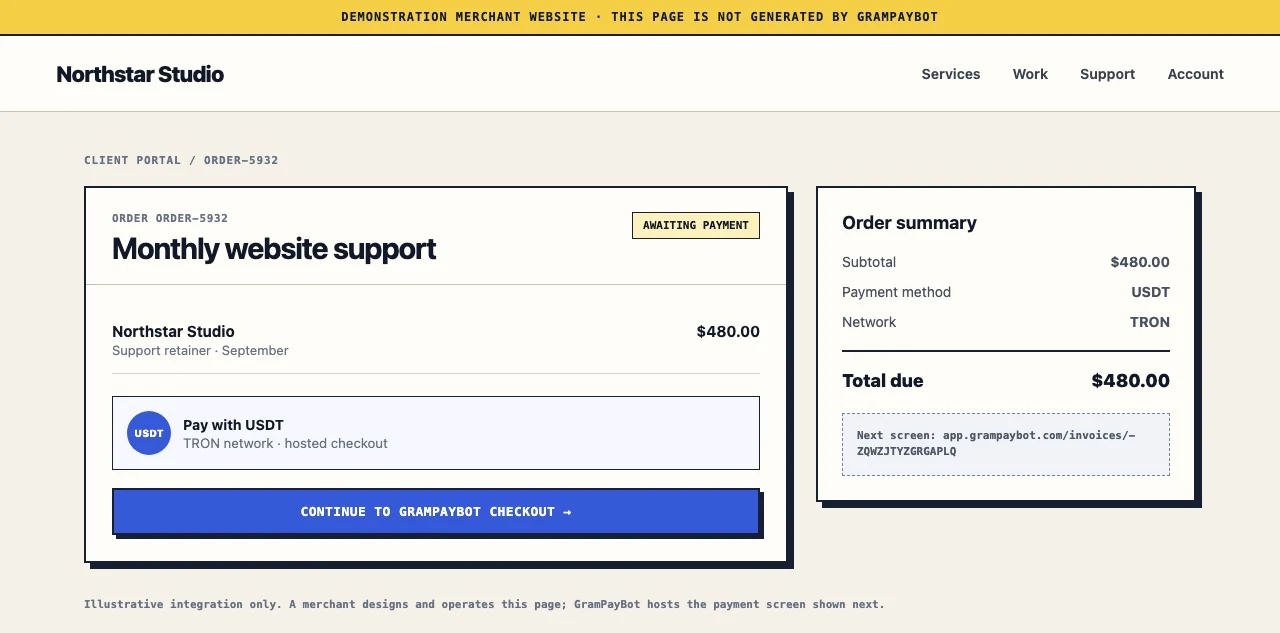
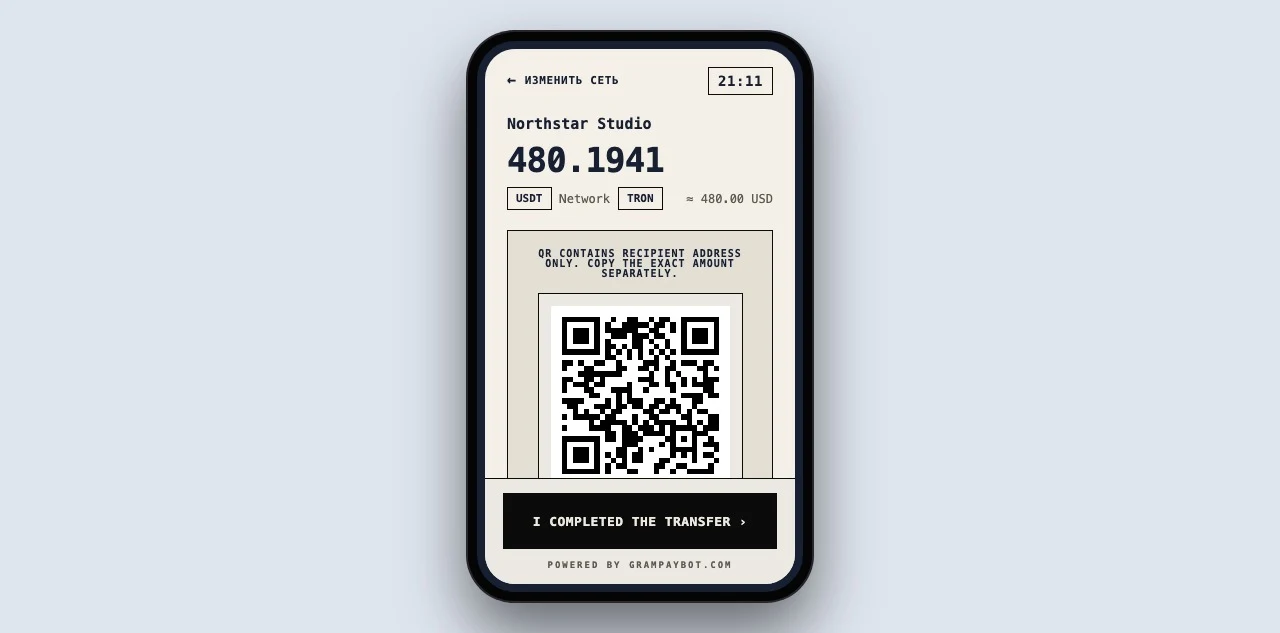
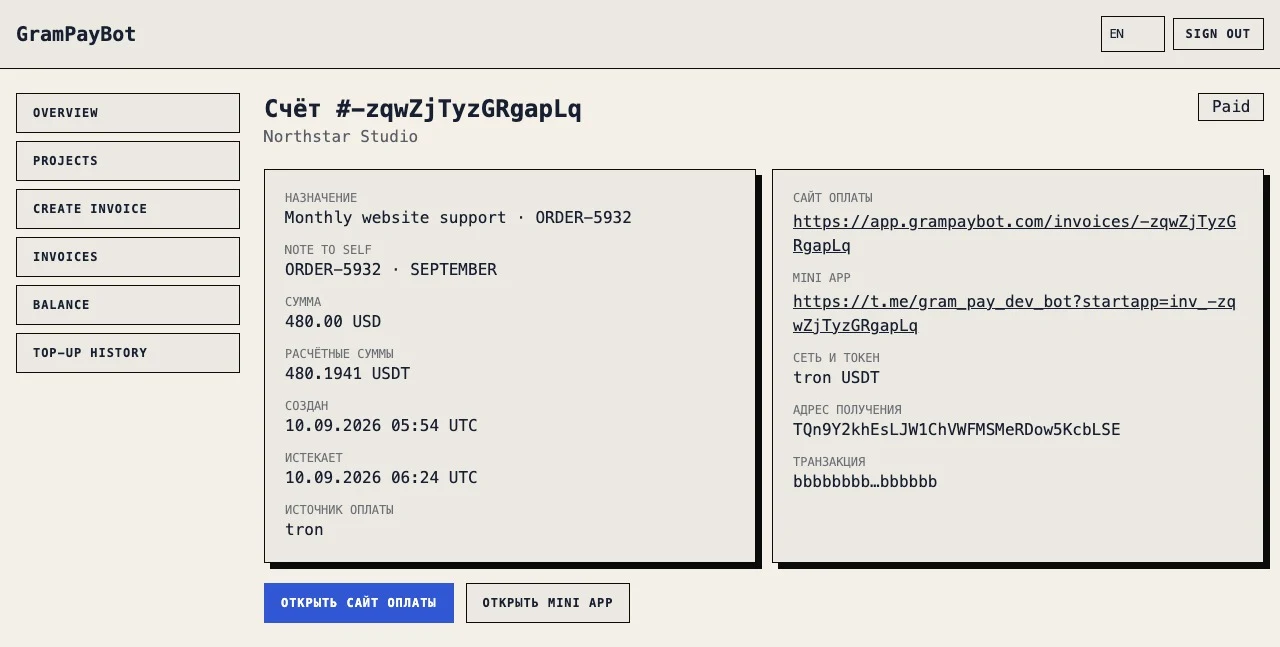
The following USDT/TRON example combines a labelled merchant-site illustration with actual current GramPayBot checkout and cabinet screenshots captured using synthetic data:
Actual GramPayBot UI captured from the current product with synthetic data. The merchant website is an illustrative integration.
Launch with a controlled test
Begin with one product, one USDT route and a low-value real transfer. Confirm that checkout shows the intended network and address, funds arrive in the correct wallet, the invoice reaches the expected state and the business record retains the original order reference and transaction hash. Then test expiry, a repeated webhook and one incorrect amount without allowing automatic fulfilment.
Expand only after the team can explain the entire path from order creation to reconciliation. A reliable USDT payment flow is complete when the buyer receives one unambiguous instruction and the business receives one order-linked, verifiable result.
Next step
Automate payment verification on your website
Create an invoice for each order, let the buyer pay through hosted checkout and receive an order-linked result.
Explore website payments →