
Stablecoin payments for online business let a customer pay in a token such as USDT or USDC while the merchant keeps the order priced in a familiar unit such as US dollars. A reliable setup still needs an exact token and network, a unique invoice, clear checkout instructions, on-chain confirmation and a rule for connecting the transfer to the correct order. The business must also decide whether funds should arrive directly in its wallet, remain in a provider balance or be converted to fiat. Stable value reduces the price volatility associated with assets such as BTC or ETH, but it does not remove issuer, network, custody, compliance or operational risk. Stablecoin payments work best when customers already use them and the merchant can explain the complete path from checkout to reconciliation.
| Decision | Practical answer | Why it matters |
|---|---|---|
| Who should offer stablecoins? | A business with real customer demand or a useful cross-border payment case | Adding an unused payment method creates work without improving conversion |
| Which asset? | A specific token that customers hold and the business is prepared to receive | USDT and USDC have different issuers, availability and network coverage |
| Which network? | Only an exact token-network route supported by checkout, customer wallet and merchant wallet | The same ticker on two networks is not the same payment route |
| How should payment be requested? | A unique invoice or payment session for each order | A reusable address cannot reliably identify who paid for what |
| When is an order paid? | After the tracked invoice satisfies the defined on-chain confirmation rule | A screenshot or browser redirect is not settlement evidence |
| Where should funds land? | Direct wallet, provider balance or converted settlement, chosen deliberately | Custody changes access, refunds, fees and counterparty exposure |
| What should be tested? | Normal payment, expiry, wrong route, incorrect amount, refund and reconciliation | Most operational differences appear outside the happy path |
When stablecoin payments for online business make sense
Stablecoins are most useful when they solve a payment problem that already exists. International customers may hold USDT or USDC but lack a convenient card or bank-transfer route, while a crypto-native client may simply prefer to pay from an existing wallet. A merchant may also want the order value to remain understandable in dollars instead of changing between checkout and settlement with a volatile asset. These are concrete reasons to add a payment method, unlike a general desire to appear innovative. Before choosing software, ask a representative group of customers which token, network and wallet or exchange they would actually use.
Customer demand is only one half of the decision because the merchant must operate what it accepts. Someone needs to secure the receiving wallet, recognize supported routes, reconcile invoices, handle unusual transfers and decide whether funds will be held or converted. The business also needs a lawful accounting and compliance process for its jurisdiction, even when the provider handles part of onboarding or screening. If no one owns those tasks, a new checkout option can create more support work than revenue. Stablecoins should therefore complement existing payment methods where they improve access, not automatically replace cards or bank transfers.
Understand what stable value does and does not guarantee
A fiat-referenced stablecoin is designed to track a currency, but its price is not a legal promise that every holder can always redeem one token for one dollar under every condition. The issuer, reserve structure, redemption rules, banking relationships, token contracts and secondary-market liquidity all affect the risk. Circle describes USDC as redeemable 1:1 and publishes reserve information and monthly assurance reports on its official transparency page. Tether states that its tokens are backed by its reserves and publishes circulation and reserve information through its official transparency page. A merchant should read current issuer disclosures instead of treating the word stable as a substitute for due diligence.
The token is also distinct from the blockchain route on which it moves. Tether’s supported-protocol documentation lists USDt contracts across several blockchains and explicitly asks integrators to state which protocols they support. That warning matters to an ordinary merchant because USDT on TRON cannot be sent to an Ethereum-only route merely because both interfaces display USDT. The same principle applies to USDC and to wrapped or bridged versions that may not be the native token a payment system expects. Record the official contract or mint behind every enabled route and verify it in the actual checkout product, not only on a provider’s general asset page.
Price stability also does not make a blockchain transfer reversible. Once a customer sends a valid transaction, the merchant cannot ask the network to cancel it in the way a card authorization might be voided. Issuers and regulated service providers may retain controls of their own, and policies can change after legal or risk events. FATF’s 2026 report on stablecoins and unhosted wallets discusses financial-crime risks and technical controls such as blocking or freezing. For a business, the practical conclusion is simple: stablecoin payment policy needs the same seriousness as any other payment and treasury policy.
Choose the acceptance model before choosing a provider
Three services can all advertise stablecoin checkout while delivering completely different outcomes. A direct-wallet tool can generate and monitor an invoice while the customer’s transfer goes to an address controlled by the merchant. A custodial processor can credit a provider balance and allow withdrawal later. A converted-settlement product can accept a token from the customer while the merchant receives fiat or another asset. Those models change counterparty exposure, access to funds, refund responsibility, eligibility requirements and total cost, so custody and settlement belong at the beginning of the decision.
| Acceptance model | Customer experience | Merchant outcome | Main responsibility |
|---|---|---|---|
| Raw wallet address | Customer constructs the transfer from instructions | Funds reach the merchant wallet | Merchant identifies and verifies every payment |
| Tracked payment link | Customer opens an invoice-specific checkout | Funds can go directly to the configured wallet | Merchant manages wallet, exceptions and refunds |
| Custodial gateway | Customer pays through provider checkout | Provider credits an internal balance | Merchant depends on provider access and payout rules |
| Converted settlement | Customer sends a supported stablecoin | Merchant receives fiat or another settlement asset | Provider handles conversion under its eligibility rules |
| Self-hosted processor | Customer uses merchant-operated checkout | Settlement follows the merchant’s infrastructure | Merchant operates software, nodes, security and monitoring |
Current product documentation demonstrates why these categories must not be blurred. Stripe’s stablecoin documentation says completed payments settle in the merchant’s Stripe balance in USD and lists geographic and transaction limitations. Coinbase Payment Acceptance describes an enterprise product with USD or USDC settlement and its own onboarding model. A direct-to-wallet gateway solves a different job because it does not convert or hold the merchant’s incoming revenue. None of these models is universally better, but the merchant should be able to draw the path of funds without using the vague phrase crypto processing.
Select token and network routes from real customer behavior
Supporting more networks is not automatically better. Every additional route creates another address configuration, refund path, wallet balance and support scenario that the team must understand. Start with payment data or customer interviews, then enable the smallest set that covers meaningful demand. Confirm that the customer’s wallet or exchange can withdraw the exact token over that network and that the merchant wallet can receive and later move it. The wallets and networks guide explains how those settings affect what a buyer sees in GramPayBot checkout.
If the business has already chosen USDT, use the focused guide to accepting USDT payments online to select a manual, payment-link or API workflow and connect each transfer to the correct order.
If customers prefer USDC, the separate guide to accepting USDC payments online covers native versus bridged token representations, official contracts and the supported-network decision without duplicating the USDT workflow.
A hosted checkout should make the irreversible details difficult to misunderstand. It should show the payment purpose, exact token amount, selected network, full address, QR code, remaining time and current status in one place. A ticker without a network name is incomplete, while a QR code without visible text is difficult to verify when the customer changes devices. Test checkout on mobile and desktop and pay once from a self-custody wallet and once from an exchange account. The correct design is the one that prevents the customer from reconstructing instructions across an email, a chat message and a wallet screen.
Availability must be checked at product level rather than company level. A provider may support a blockchain in one wallet product but not in its checkout, invoice API or settlement feature. Routes, limits and merchant eligibility can also change by location and account type. Save a dated matrix of the token-network pairs confirmed for production and assign an owner to review it periodically. Do not copy a permanent network list into customer communication if the checkout itself is the current source of truth.
Connect every transfer to a unique order
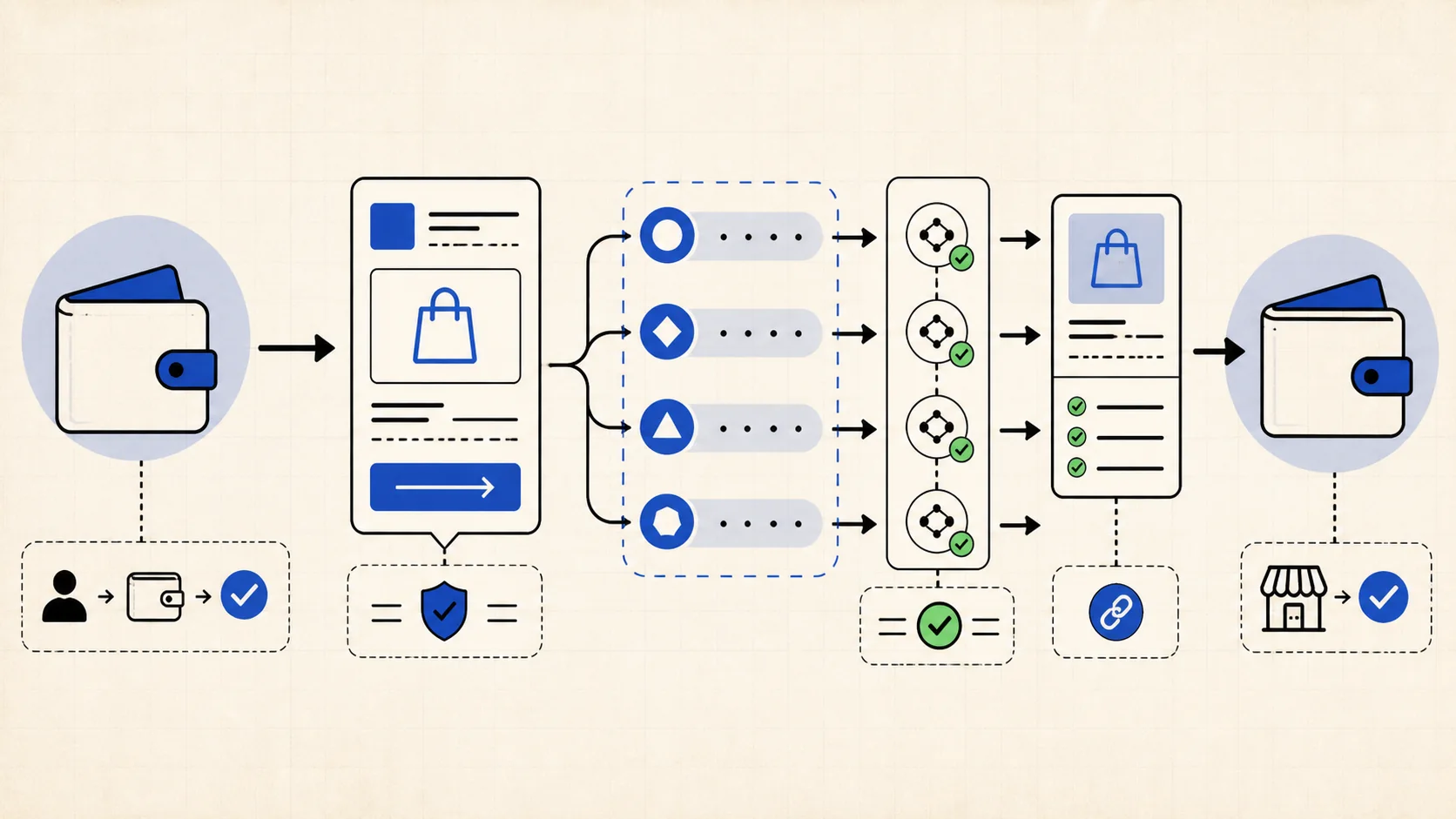
The business should create its local order before requesting payment and preserve its own immutable reference in the payment record. One payment session or invoice should represent one obligation, such as an ecommerce order, project deposit or service-credit purchase. The provider returns its invoice identifier and hosted checkout URL, and the merchant stores that identifier beside the local order. When payment is confirmed, the result should return the expected and received amount, token, network, status and transaction hash with the same order context. This is how the business knows which customer paid without scanning a wallet balance or guessing from a rounded amount.
A reusable wallet address does not provide that structure by itself. Two customers can send the same amount close together, one customer can pay an old instruction, and a transaction hash can be presented twice. A unique invoice gives each payment a defined amount, time window and business purpose even when the receiving wallet is shared. The system must also reject the same transaction hash as evidence for a second order. The complete matching logic is explained in automated crypto payment verification.
The browser is part of the customer experience, not the final authority on fulfilment. A buyer can close the tab, revisit a return URL or manipulate client-side state without changing the blockchain. The merchant should update an order only after a trusted server-side status check or authenticated webhook connects the valid transfer to the correct invoice. Fulfilment must be idempotent so a repeated event cannot ship two products, activate two plans or add the same balance twice. This principle applies whether the payment amount is five dollars or fifty thousand dollars.
Define confirmation, expiry and exception rules before launch
Every payment state needs one business meaning and one permitted action. Waiting means no accepted transfer has yet satisfied the rule, paid means the tracked evidence is sufficient for the merchant’s fulfilment policy, expired means the active payment window ended, and cancelled means the request should no longer be used. A provider may expose additional states for a detected or processing transaction, but those names are useful only when the team knows whether fulfilment is allowed. Write the order-to-payment mapping before integration so developers and support staff do not invent different interpretations during an incident.
The exception policy should cover at least these situations:
- the customer uses the wrong token or network;
- the received amount is below or above the invoice amount;
- payment arrives after expiry or after the order changed;
- a transaction is visible but has not met the confirmation rule;
- the same transaction hash is submitted for another order;
- the customer requests a refund after funds reached the merchant wallet.
An unusual transfer should remain visible with its actual evidence even when it cannot close the order automatically. The provider should not silently assign it to the nearest amount or hide it behind a generic failed label. Direct-to-wallet settlement means the merchant, not the gateway, decides and sends any refund from its own wallet. Staff should know who can approve that action and which address evidence is required. A small pilot is the right time to test these rules, not the first day a real customer pays incorrectly.
Plan custody, treasury, records and compliance together
Receiving directly to a merchant-controlled wallet removes a provider payout step but moves more responsibility to the merchant. The business controls access, signs outgoing refunds, pays network costs when moving funds and decides if or when to convert. Use a dedicated business wallet policy, limit who can initiate transfers and separate public receiving addresses from private keys or seed phrases. A payment provider needs only the public address for a non-custodial route and should never ask staff to paste a seed phrase into a dashboard. The crypto payment gateway selection guide compares this responsibility split with custodial and converted settlement.
Payment records should connect the commercial obligation, invoice and blockchain transaction. Keep the local order or contract reference, invoice ID, expected amount, received amount, token, network, timestamps, status and unique transaction hash. Record the fiat value and accounting treatment required by the business’s jurisdiction through the appropriate accounting workflow. A payment request generated by software is not automatically a tax invoice or legal document. Contracts, statutory invoices, receipts and tax filings remain separate obligations unless a qualified adviser confirms otherwise.
Stablecoin acceptance does not remove customer, sanctions, tax or licensing considerations. Requirements depend on the merchant, activity, countries, counterparties, custody model and services performed by the provider. Use provider screening and onboarding as one control, not proof that every transaction is lawful for the merchant. Establish a process for suspicious payments, blocked assets, refunds and record retention with professional advice where the consequences are material. This article explains payment operations and is not legal, tax or compliance advice.
Compare total cost instead of one processing rate
The real cost includes more than the fee printed beside checkout. Add any subscription, percentage or fixed processing charge, conversion spread, payout fee, blockchain network cost, refund work, package expiry, infrastructure and internal reconciliation time. A percentage model grows with order value, a fixed fee grows with the number of successful payments, and a subscription remains payable during a quiet month. The right model therefore depends on both transaction count and average order value. The separate guide to a crypto payment gateway without a monthly fee shows how to calculate those tradeoffs without comparing unlike services by one headline number.
Cost must be interpreted beside settlement and included work. Stripe’s public pricing currently lists stablecoin acceptance as a percentage of transaction value and says that conversion to fiat, wallet and AML screening, fraud prevention and gas sponsorship are included. A direct-wallet service does not deliver the same settlement outcome, so a lower processing number does not mean the products are interchangeable. Self-hosted software can remove a conventional processor fee while still requiring hosting, monitoring, upgrades and qualified operators. Build scenarios for a quiet month, expected volume and growth month, then calculate the cost and responsibilities of the full path.
How GramPayBot fits a stablecoin payment workflow
GramPayBot fits a business that wants to price an invoice in USD, let the customer pay in supported USDT or USDC routes and receive funds directly in a configured public wallet. The merchant can create payment links manually for negotiated sales or create invoice-specific checkout sessions through the API for website orders. Checkout shows the payment details, while GramPayBot monitors the expected route and returns status and transaction context through the dashboard, API or signed webhook. There is no internal merchant revenue balance, automatic fiat conversion or provider-controlled payout stage. The website stablecoin payment flow shows how this model connects an existing order to checkout and fulfilment.
Current supported routes include USDT on Ethereum, Optimism, BNB Smart Chain, Base, Polygon, Arbitrum, TRON and Solana, and USDC on Ethereum, Optimism, BNB Smart Chain, Base, Polygon, Arbitrum and Solana. Treat that list as current product information rather than a permanent promise, and verify the live configuration before accepting a material payment. Enable only routes the business can receive, secure and refund. Review current pricing separately because processing packages and product details can change. GramPayBot is a payment tracking tool, not a wallet custodian, exchange, accounting platform or compliance adviser.
Run a small production pilot before a wider launch
Start with one product or service, one internal owner and the minimum token-network routes needed by real customers. Create a low-value order, follow the hosted checkout, confirm that funds reach the intended wallet and verify that the invoice status returns the original order context. Then test expiry, a repeated notification, an incorrect amount and the documented refund path. Reconcile the paid invoice against both the commercial record and the blockchain transaction. Only expand routes or automate fulfilment after the team can explain and reproduce every step.
A good pilot produces a written operating decision rather than only a successful transaction. Record who owns wallet security, route changes, unusual payments, customer communication, refunds, conversion and accounting exports. Set the exact state that permits fulfilment and make every downstream action safe against duplicate events. Keep existing card or bank methods available unless the business has a clear reason to remove them. Stablecoin payments are ready when the customer sees one unambiguous instruction and the business receives one order-linked, auditable result.
Next step
Automate payment verification on your website
Create an invoice for each order, let the buyer pay through hosted checkout and receive an order-linked result.
Explore website payments →